
Your Pet Travel Checklist: Everything You Need Before Moving Day
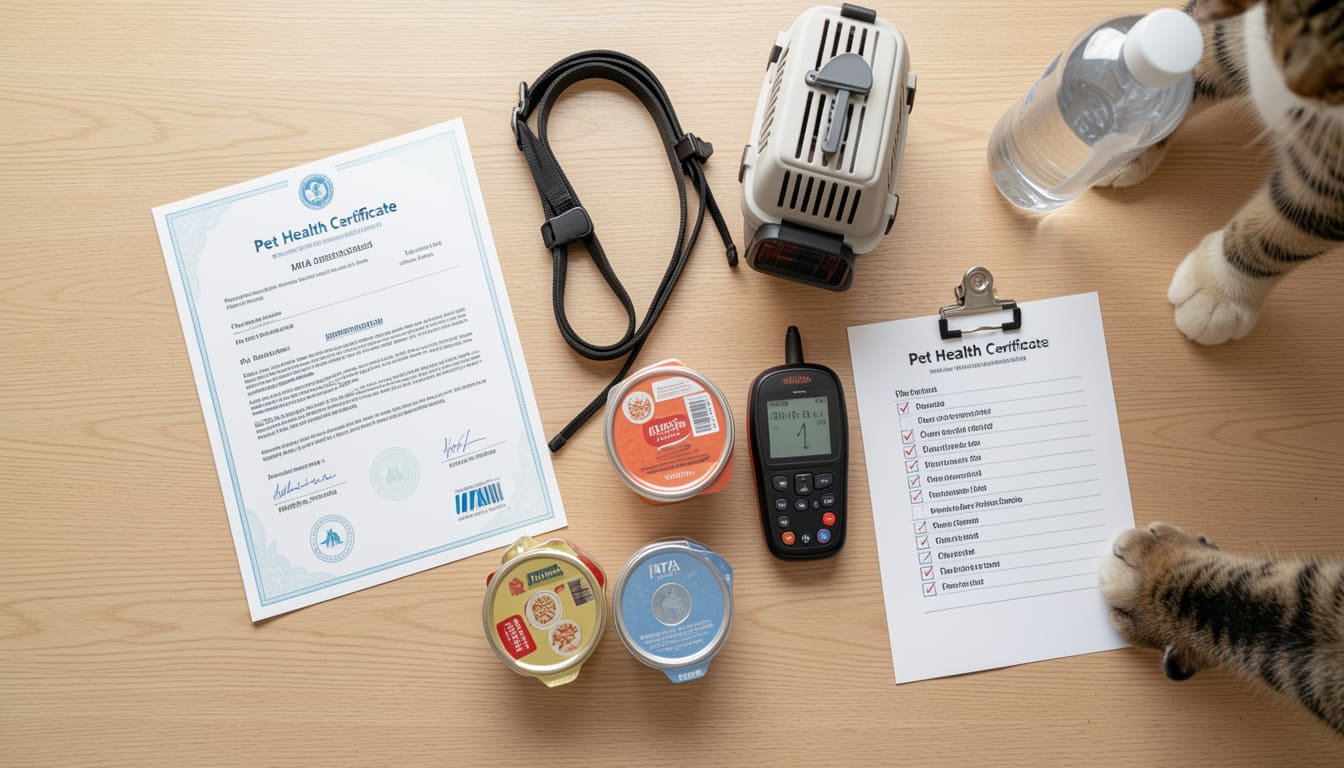
Your complete pet travel checklist
Moving with a pet involves dozens of steps, and missing one can delay your entire trip. This checklist covers everything from the earliest planning stages through travel day and arrival. Use it as your master reference, whether you are moving across the country or across the world.
3 to 6 months before travel (international moves)
- Research your destination country’s pet import requirements (our destination guides cover 30+ countries)
- Confirm your pet’s microchip is ISO 15-digit standard and registered with current contact info
- Verify rabies vaccination is current and was given after the microchip was implanted
- Schedule a rabies titer test if required by your destination (Japan: 180 days before arrival; Australia, Singapore, Hawaii: varies)
- Apply for an import permit if required (Australia, Singapore, New Zealand, and others)
- Contact a pet relocation service for a detailed plan and quote (request a quote)
6 to 8 weeks before travel
- Book the airline and flight (cargo space is limited; book early)
- Purchase or confirm your IATA-compliant crate (sized so your pet can stand, turn around, and lie down)
- Start crate training: let your pet eat, sleep, and spend time in the crate daily
- Schedule any required vaccinations or boosters (some must be given within specific timeframes)
- Schedule parasite treatments if required (UK: tapeworm treatment 24 to 120 hours before entry)
- Arrange ground transport if needed (for brachycephalic breeds or if connecting to a departure airport)
2 to 4 weeks before travel (domestic moves)
- Check your airline’s pet policy and book the pet on your flight (or a cargo slot)
- Confirm crate requirements with the airline
- Schedule a vet visit within the required window (usually within 10 days of travel)
- Start crate training if you have not already
10 days before travel
- Visit a USDA-accredited veterinarian for the health certificate exam (international moves require a USDA-endorsed health certificate)
- Confirm microchip reads correctly during the exam
- Complete any destination-specific treatments or forms at this visit
- Submit the health certificate to USDA APHIS for endorsement (international moves)
- Confirm the airline booking and any special handling instructions
3 to 5 days before travel
- Pick up the endorsed health certificate from USDA APHIS (or confirm electronic delivery via VEHCS)
- Assemble all documents in one folder: health certificate, vaccination records, microchip documentation, import permit (if applicable), titer test results (if applicable), airline confirmation
- Prepare the crate: attach water dish, line with absorbent bedding, apply “Live Animal” stickers and directional arrows, tape your contact info and a photo of your pet to the outside
- Check the weather forecast at all airports on the route (look for heat or cold embargo conditions)
The night before travel
- Give your pet a light meal (no heavy feeding within 4 to 6 hours of the flight)
- Make sure your pet has access to water
- Place a familiar item in the crate (a t-shirt with your scent, a small toy)
- Double-check that all documents are printed, organized, and in your carry-on
- Confirm pickup time and location if using a relocation service or ground transport
- Set alarms and plan to arrive at the airport early
Travel day
- Take your pet for a walk or bathroom break before leaving for the airport
- Place your pet in the crate with the water dish attached (freeze water beforehand to prevent spilling during transport)
- Arrive at the airport early: at least 3 hours before an international flight, 2 hours before domestic
- Check in at the airline’s cargo facility (for cargo travel) or at the ticket counter (for in-cabin)
- Present all documents to the airline staff
- Confirm your pet is on the flight manifest before boarding yourself
- Do not sedate your pet. American will not accept a dog or cat that has been sedated or tranquilized, and Delta does not permit sedation of the dogs and cats it ships.
After arrival
- Pick up your pet from the cargo facility or customs area promptly
- Offer water immediately
- Check your pet for any signs of stress or discomfort
- Allow time for your pet to decompress in a quiet space
- Set up their area in the new home with familiar items (bed, bowls, toys)
- Keep routine consistent: same feeding schedule, same walk times
- See our guide on helping your pet settle after a move for more tips
The document pack: what travels with your pet
Every move needs a physical folder that travels with the pet, plus copies in your own bag. Digital copies help, but handlers and border officers work off paper.
- Current rabies certificate showing the vaccination date and product used.
- Health certificate: for domestic moves a certificate of veterinary inspection issued within 10 days of travel; for international moves the destination country’s certificate, endorsed by USDA APHIS.
- Microchip number, and for international moves confirmation it is a 15 digit ISO chip, implanted before the rabies vaccination that counts.
- Rabies titer lab report for titer countries such as Japan or Australia.
- Import permit for countries that require one, such as Australia or New Zealand.
- A clear photo of your pet and of the crate, which speeds things up if anything needs to be identified in transit.
Crate sizing in two minutes
Measure your pet’s length from nose to base of tail and height standing, ears up. The crate needs room to stand without ears touching the top, turn around fully, and lie down stretched. Where the animal sits between two sizes, go up, but measure first rather than guessing: there is a published formula and going up a size is charged for. Our guide to what size crate your pet needs sets out the calculation. The crate must meet the IATA standard, the airline rulebook for live animal containers: hard sided, metal bolt fasteners rather than plastic clips, ventilation on multiple sides, a water bowl fixed to the door, and absorbent bedding inside.
Then give it weeks, not days. Feed meals in the crate, leave the door open at home, and let it become a den. Crate acclimation is the single cheapest thing that improves how a pet travels.
Want this as a printable list? Our free two page checklist covers every step in order, from the first vet visit to travel day, with space for your own notes.
Frequently asked questions
What is the most commonly missed step?
The timing of the health certificate. It has to be issued and endorsed within a narrow window before travel. Getting the vet visit too early or too late is the most common reason pet shipments get delayed.
Do I need all of these steps for a domestic move?
No. Domestic moves are simpler. You typically need a health certificate from your vet, a current rabies vaccination, and an airline-approved crate. Skip the international sections (import permits, titer tests, USDA endorsement) unless you are flying to Hawaii.
Can Pet Travel Advisors handle all of this for me?
Yes. We manage the entire process: documents, vet coordination, airline booking, crate logistics, and travel day. Request a quote and we will tell you exactly which steps apply to your move and handle them for you.
What documents should I keep copies of?
Keep copies (paper and digital) of: the health certificate, vaccination records, microchip registration, titer test results, import permit, and airline booking confirmation. Have them accessible on your phone in case the paper copies are needed at multiple checkpoints.
What documents does my pet need to fly within the US?
A current rabies certificate and, for most states and airlines, a certificate of veterinary inspection issued by an accredited vet within 10 days of travel. Your vet clinic sets the fee for the exam, so ask when booking.
How do I know the crate is the right size?
Your pet should stand without ears touching the top, turn around fully, and lie down stretched out. If it is close, size up. Airlines can refuse a crate that is too small at check-in, which is an expensive way to find out.
Sources
Checked August 2026.
- USDA APHIS, pet travel process overview. The five step sequence, and the reason timing is tight: an endorsed certificate can be valid for as little as 30 days.
- AVMA, traveling with your dog or cat. Restraint, rest breaks, carrier acclimation, and why a pet is never left alone in a parked car.
- IATA, pet corner for travelers. Crate sizing by formula, advance airline confirmation, pre-flight feeding, and the case against sedation.
Last updated