
Pet Transport Services in the United States
Pet Travel Advisors arranges pet transport on three lanes: within the United States, outbound to another country, and inbound from abroad. The animals we relocate are dogs, cats, birds and other small pets, and we plan each move around the rules that govern its lane: the airline’s, the destination’s and, for a dog arriving in the country, the CDC’s.
This page explains how each lane works, the three ways a pet can fly, and the parts of a relocation that are hard to get right alone. It links to the guides that go deeper and ends at the quote form.
Three Lanes, and Who Writes the Rules for Each
The lane decides which authority you answer to. Knowing it first keeps you from booking a flight around the wrong paperwork.
Within the United States
APHIS says the receiving State or Territory sets the requirements for moving a pet within the country, and they can include a health certificate, updated vaccinations, diagnostic testing or treatments. The airline adds its own. Alaska Air Cargo asks for a health certificate from a licensed veterinarian for every warm-blooded animal it carries as cargo, based on an examination within 10 days of travel, or within 14 for a dog or cat flying to Hawaii.
From the United States to Another Country
The destination country sets the entry requirements, and APHIS says they can change at any time. An accredited veterinarian completes the health certificate, and where the destination requires it, APHIS endorses it before your pet leaves.
Into the United States From Abroad
For a dog, APHIS names the CDC as the primary federal authority, and that includes an American dog coming home. What the CDC asks for depends on where the dog was vaccinated and which countries it has been in during the six months before arrival, and the destination state can add requirements of its own.
Each lane has its own service page and guides. Domestic pet shipping deals with moves between states, and moving to Hawaii with pets covers that route on its own. International pet shipping and the destination guides cover relocations abroad, and bringing your pet to the USA is about the inbound lane. APHIS links the rules for every State and Territory from its interstate pet travel page.
Cabin, Checked Baggage or Cargo
There are three ways a pet can fly. The same animal on the same aircraft can fly in the cabin, as checked baggage or as cargo, depending only on how it was booked. Those are separate products with their own rules, not three names for one service. Two of them load the animal into the hold, and what separates those two is whose booking the pet is on.
In the Cabin
A cat or small dog rides in a carrier stowed beneath the seat ahead, booked on your ticket. In the cabin, American takes one pet carrier per passenger and Delta one kennel. JetBlue allows two pets per traveler, each in its own carrier, and the second needs an extra seat and pet fee. Delta says the aircraft sets its in-cabin maximum, and recommends a soft-sided kennel of 18 by 11 by 11 inches.
As Checked Baggage
The pet goes in the hold as part of your reservation, which puts you on the same flight. American accepts checked pets only for active-duty US military and US State Department Foreign Service personnel on official orders.
As Cargo
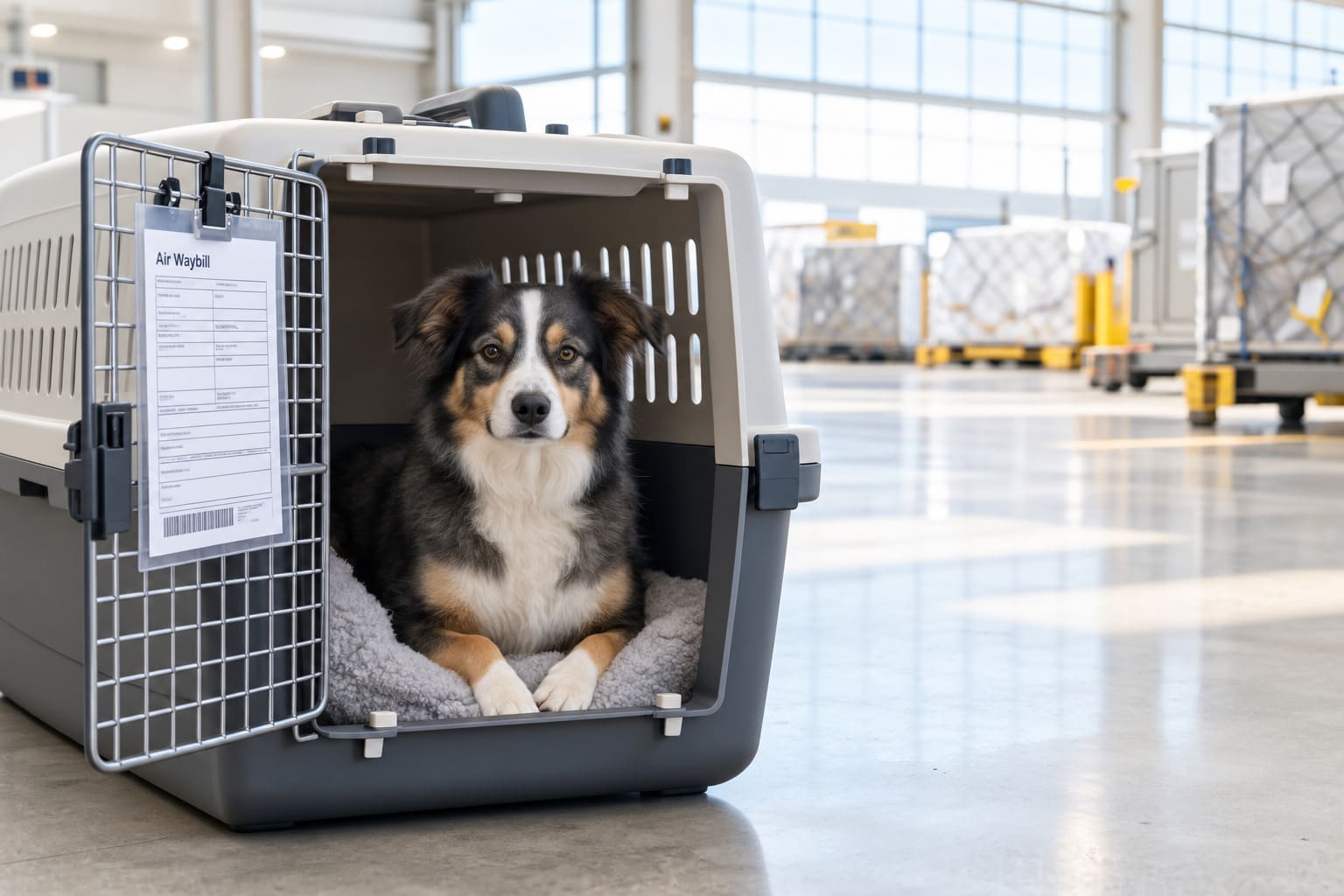
Your pet travels as a shipment of its own, documented on an air waybill and booked with the airline’s cargo arm, with or without you on board. Delta says a shipped pet is dropped off and picked up at a cargo location apart from passenger check-in, and is not guaranteed the same flight or schedule as its owner. American says a pet too large for its cabin has to travel as cargo.
The right one for your pet depends on its breed and size, which airline, the time of year and the route, and a quote settles it before anything else. Delta ships pets only for active US military and State Department Foreign Service personnel with permanent change of station orders. American Airlines Cargo carries pets that qualify neither for the cabin nor as checked baggage through its PetEmbark service.
Our guides to the American, Delta, Alaska and JetBlue pet policies, and our comparison of US airline rules, set out each carrier in detail. For the hold, airline crate requirements and the IATA sizing formula cover the kennel. Our pet carrier size checker sets IATA’s minimum for your dog or cat beside the under-seat limits that US and Canadian airlines publish. Our airline crate size calculator works out IATA’s minimum inside dimensions for your dog or cat’s travel crate.
What Is Genuinely Hard
Booking a flight and packing a crate are ordinary logistics. Three parts of a relocation are harder, and they are where planning earns its keep, whether or not you hire anyone for it.
Sequencing the Documents
Pet paperwork is a chain, and several links count only if an earlier one was made first. For a dog covered by its rules for high-risk countries, the CDC says the microchip has to be implanted before the rabies vaccine is given, or that vaccination is invalid.
For a dog vaccinated in the United States that will visit a high-risk country and come home, the CDC’s route runs through its Certification of U.S.-Issued Rabies Vaccination, completed by an accredited veterinarian and endorsed by USDA before departure, and APHIS says that form cannot be issued retroactively once the dog has gone. The CDC adds that a USDA-endorsed export health certificate issued after July 31, 2025, will not be accepted for re-entry.
On an export, the destination’s clock runs underneath all of it. Vaccinations, any test and the health certificate each have to fall inside the window that country sets, and the paperwork then has to be endorsed and in your hands before the flight. Our guide to APHIS endorsement walks through that timeline.
Booking Freight
Freight runs on the carrier’s terms rather than a passenger’s, and each airline publishes its own. Alaska Air Cargo takes a Pet Connect reservation no later than 24 hours before travel. It says the animal must be collected within four hours of arrival by someone showing photo ID. American Airlines Cargo requires a customs broker for a live animal shipment going to a location outside the United States, and leaves the destination clearance fees to the customer.
Weather decides the rest. American checks the actual or forecast temperature at each flight’s departure and arrival time for every station on the itinerary. American transports warm-blooded animals when ground temperatures are between 45F and 85F. Below that it requires a letter of acclimation signed and dated by a licensed veterinarian, which covers 20F to 44F, and it will not carry an animal at all below 20F. American says pets outside the cabin cannot travel to, through or from Phoenix, Tucson, Las Vegas or Palm Springs from May 1 to September 30. Alaska Air Cargo says many of its stations have seasonal temperature embargoes for animal shipments over a summer season that generally runs from May 1 to October 16. So a route open to pets in April can close in May.
Spotting a Refusal Before You Book
It is cheaper to find out a plan will fail before anything is paid for than at the check-in counter. The refusals below come from the carriers’ and agencies’ own published rules, and each is theirs to change.
American and Delta will not carry brachycephalic, or snub-nosed, dogs and cats in the hold, and Alaska Air Cargo says it generally does not accept them there. Alaska Air Cargo says it will not accept French and English Bulldogs in the hold, whether shipped or checked, from July 31 to September 30, 2026. American will not accept a dog or cat that has been sedated or tranquilized, and Delta does not permit sedation of the dogs and cats it ships.
For an arriving dog, the CDC says one that has been in a high-risk country for dog rabies in the past six months and is not vaccinated against the disease will not be allowed to enter. When we read its animals page on September 15, 2026, American Airlines Cargo had embargoed new bookings for dogs originating in a CDC high-risk country for rabies, including a dog that had been in one within six months of the travel date.
Each refusal here belongs to one carrier, one season or one entry rule, not to pet transport as a whole. American Airlines Cargo’s PetEmbark and Alaska’s Pet Connect both carry animals in the hold, and the summer limits above have published end dates, so a no on one route or in one month is where the planning starts.
APHIS Endorsement and Its Timing
When a destination requires a USDA-endorsed health certificate, APHIS sets out the steps in order: an accredited veterinarian works out the destination’s requirements, completes and signs the document, it goes to APHIS for endorsement, and the original endorsed certificate travels with the pet. APHIS says only an accredited veterinarian can issue a certificate that USDA endorses, and that accreditation is voluntary and specific to each state, so your usual clinic may not be able to do it.
Timing is where these moves slip. APHIS offers two routes in: the veterinarian submits through its Veterinary Export Health Certification System, VEHCS, or the paper certificate is mailed to an endorsement office, which APHIS discourages. It calls VEHCS the fastest, says processing there is staffed Monday through Friday from 7:00 a.m. to 4:30 p.m. Central Time outside federal holidays, and says there is no in-person or drop-off service.
The destination sets how long a signed certificate stays acceptable, and the example APHIS gives is 30 days, so the endorsement has to land inside that window with time left to travel. APHIS advises submitting as early as the destination’s timeline allows, and warns that incomplete or incorrect certificates are delayed until they are corrected. Its endorsement offices cannot provide status updates, APHIS says, and your veterinarian can check progress in VEHCS.
Endorsement is not always the last step. APHIS names tapeworm treatment for dogs going to Finland, Ireland, Norway, the UK and Malta as one that some destinations allow afterward, and notes that some countries require consulate approval or advance notice and that airlines may have requirements of their own. Its pet travel process overview, export guidance and endorsement office tips are the sources to check before you book.
The CDC’s Rules for Dogs Entering the United States
A dog entering or returning to the United States has to meet the CDC’s dog import requirements, and those turn on two facts: where the dog was vaccinated against rabies, and which countries it has been in during the six months before arrival. The CDC’s Dog Importation Navigator sorts a dog into the right set of requirements.
A dog that has been only in dog rabies-free or low-risk countries in those six months needs one document, the CDC Dog Import Form receipt, which the CDC says is free, completed online, and needed for each dog separately. The dog must also appear healthy on arrival, be at least six months old, and have a microchip that a universal scanner can detect, and it can arrive at any airport, seaport or land border crossing.
The CDC treats a country missing from its high-risk list for dog rabies as rabies-free or low-risk. That list was dated April 15, 2026, when we read it on September 16, 2026, and it is the page to check before any trip.
A dog that has been in a high-risk country needs more. For a dog vaccinated in the United States, the CDC’s route runs through the certification described above, completed before the dog left. A dog vaccinated abroad must have a reservation at a CDC-registered animal care facility and land at the airport associated with it, among other requirements.
The CDC adds that you must also comply with USDA’s regulations and your US destination’s. APHIS says its own requirements for a pet dog apply when the dog comes from a country affected by foot-and-mouth disease or screwworm, as its page on bringing a pet dog into the United States explains. Our CDC Dog Import Form guide walks through filling it in.
The airline, APHIS and CDC rules on this page were read on each source’s own site on September 15 and 16, 2026. They change, so check the linked pages before you book.
Who Arranges Your Pet’s Move
Pet Travel Advisors was founded in 2023. Our team holds IATA Live Animals Regulations certificates, and our documentation follows USDA APHIS requirements.
Whoever you hire, ask them the questions this page raises: which lane the move is on, the way your pet will travel, who submits the endorsement and when, and what the plan is if a carrier refuses the booking. Replies in writing, before you pay, are ones you can hold a service to.
What It Costs
No rate card fits pet transport, so this page leaves figures to the quote. The total is the sum of parts that vary separately: the airline’s charge for the cabin, checked or cargo booking, the crate, the veterinary visits and any tests, the APHIS endorsement fee where the destination requires one, clearance at the other end, and our coordination. The route, the season and your pet’s size shift most of them.
Our pet shipping cost guide breaks those parts down, and there are separate breakdowns for a dog and a cat. For your own relocation, the quote is written and covers the whole move.
How to Start
Start with the route and the animal. Tell us the species, breed and rough weight, the city the move starts in and where it ends, and the month you have in mind. From that we can name the lane, the likely way your pet flies, and anything on the route that looks like a refusal.
1. Tell Us the Route and the Pet
Send the quote form or phone us. We look at size and breed first, since a snub-nosed dog or cat narrows the flights on offer.
2. A Plan and a Written Quote
You get the routing we recommend, the documents your lane needs and the order they happen in, and one written quote for everything.
3. Documents and Crate Training
Vet appointments, any test, the health certificate and its endorsement, each dated back from departure, while your pet learns to settle in its crate at home.
4. Travel Day and Arrival
On the day we pick your pet up, take care of cargo drop-off or check-in, track the flight and hand over at the destination.
Ask for a Quote on Your Pet’s Move
Frequently asked questions
Can I ship my pet as cargo with a US airline myself?
On some airlines, yes. Alaska Air Cargo takes a Pet Connect reservation no later than 24 hours before travel. It says the animal must be collected within four hours of arrival by someone showing photo ID. American Airlines Cargo carries pets that qualify neither for the cabin nor as checked baggage through its PetEmbark service. Delta ships pets only for active US military and State Department Foreign Service personnel with permanent change of station orders. For a move abroad, American Airlines Cargo also requires a customs broker for a live animal shipment going to a location outside the United States, and leaves the destination clearance fees to the customer.
How is checked baggage different from cargo?
A checked pet rides in the hold as part of your reservation, so you share the flight. Cargo is a shipment of its own on an air waybill, booked with the airline’s freight side, and it can fly with or without you. American accepts checked pets only for active-duty US military and US State Department Foreign Service personnel on official orders. American says a pet too large for its cabin has to travel as cargo.
Does my pet need a health certificate to move to another state?
That depends on the state you are moving to and on the airline. APHIS says the receiving State or Territory sets the requirements, and links each one’s rules from its interstate pet travel page. Alaska Air Cargo asks for a health certificate from a licensed veterinarian for every warm-blooded animal it carries as cargo, based on an examination within 10 days of travel, or within 14 for a dog or cat flying to Hawaii.
How long does APHIS endorsement take?
Plan around the destination’s window. APHIS calls VEHCS the fastest way to submit, says processing there is staffed Monday through Friday from 7:00 a.m. to 4:30 p.m. Central Time outside federal holidays, and says incomplete or incorrect certificates are delayed until corrected. It advises submitting as early as the destination’s timeline allows, and your veterinarian can check a submission’s status in VEHCS.
What does my dog need to enter or return to the United States?
That depends on where it was vaccinated and which countries it has been in during the six months before arrival, and the CDC’s Dog Importation Navigator sorts it out. A dog that has been only in dog rabies-free or low-risk countries needs the CDC Dog Import Form receipt and has to appear healthy, be at least six months old and carry a microchip a universal scanner can detect. A dog that has been in a high-risk country has more to do, and for a dog vaccinated in the United States some of it has to happen before the trip.
What does pet transport cost in the US?
It depends on the lane, the way your pet flies, the season and your pet’s size, which is why this page gives no figure. Our pet shipping cost guide breaks down each part, and a quote gives you one written number for your move.