
Pet Air Transport Explained: In-Cabin, Cargo, and Charter
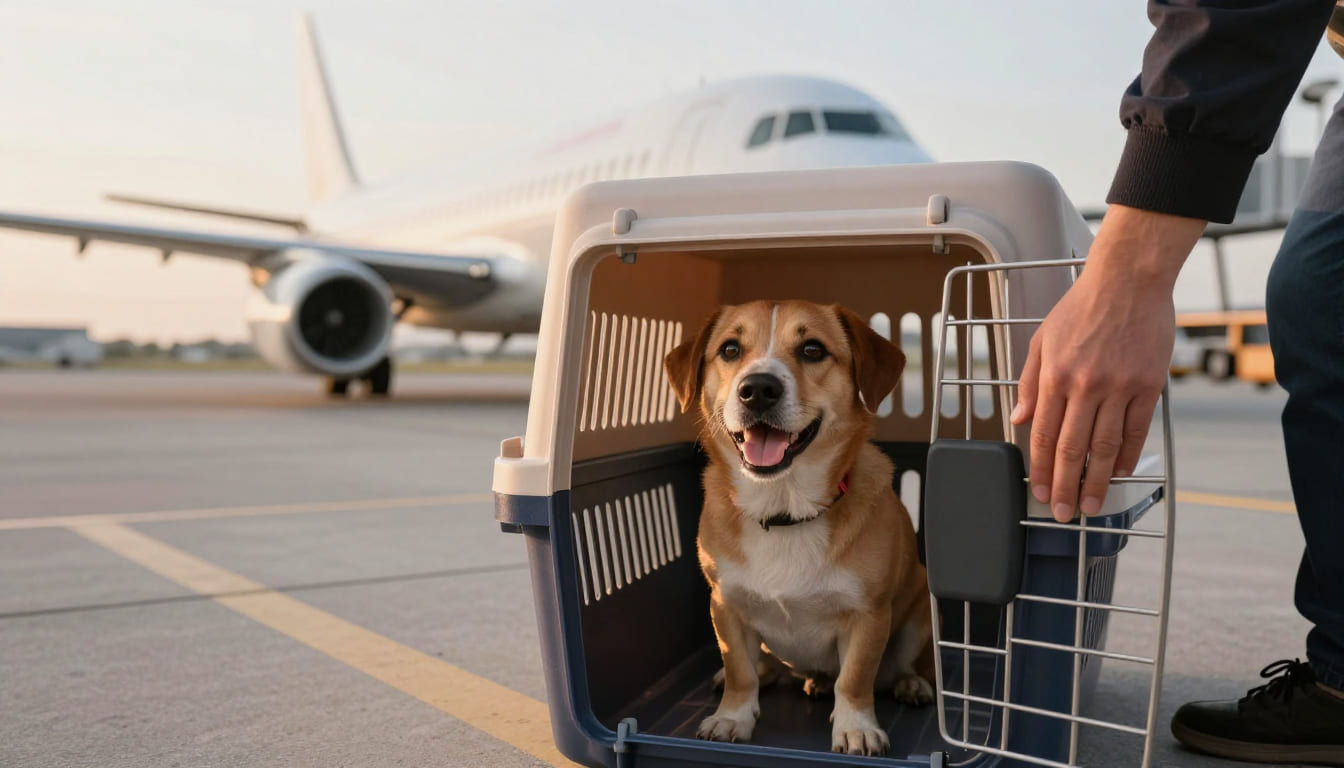
When people picture flying a pet, they usually picture one of three very different things: the small dog or cat under the seat in the cabin, the pet flying as manifest cargo in the hold, and the private charter for pets that cannot fly commercially. Knowing which one applies to your pet is the first real step in planning an air move. Here is how each works, what it costs, and how to make the flight as easy as possible.
The three ways a pet flies
- In-cabin: small dogs and cats whose carrier fits under the seat.
- Cargo: larger pets, in the hold. This is the standard for most dogs.
- Charter: for snub-nosed breeds and routes with no safe commercial option.
In-cabin: small pets only
If your pet and their carrier together fit under the seat in front of you, they may be able to fly in the cabin with you. Airlines set the carrier size, so this path is for small dogs and cats only. Spots per flight are limited, so you book the pet when you book yourself. Our comparison of Delta, United, and American pet policies covers what each carrier allows.
Cargo: widely misunderstood
Larger pets travel as cargo. American Airlines Cargo says the heat and ventilation capability of much of its fleet is what allows it to accept pets, and it does not carry animals on its Airbus A319, A320 and A321 aircraft except between New York JFK and Los Angeles or San Francisco. This is the part that worries owners most, so it is worth being clear: manifest cargo is a monitored, regulated service built specifically for live animals. Your pet needs an airline-approved crate and, for most journeys, a health certificate. For more on this, read keeping your pet safe during air travel.
Private charter: the exception, not the norm
Some pets cannot fly commercially. American and Delta will not carry brachycephalic, or snub-nosed, dogs and cats in the hold, and Alaska Air Cargo says it generally does not accept them there. Some routes or timelines simply have no commercial option. A charter solves that, at a higher cost. If your pet is a bulldog, pug, boxer, Persian, or another flat-faced breed, read our guide on breed restrictions before booking anything.
What affects the cost
Air transport pricing moves with your pet’s size and crate dimensions, the route and number of connections, the season, and whether you book it yourself or through a service. A pet in cargo commonly runs a few hundred to a couple of thousand dollars in airline fees, with full-service coordination on top. Our cost guide has the full breakdown.
How to make the flight easier on your pet
- Fly direct whenever you can. Connections are where delays and stress build up.
- Acclimate your pet to the crate for two to three weeks before travel.
- Avoid sedatives unless your vet specifically advises them, because they can affect breathing at altitude.
- Watch the season. Our guides on summer heat embargoes and winter pet travel explain temperature limits.
- Feed a light meal several hours before, not right before, and attach the water dish inside the crate.
Where a relocation service fits
Booking a pet on a flight involves crate sizing, airline live-animal rules, and timing that changes by season and route. Rather than decode it yourself, explore our pet transport services or request a quote and we will tell you the best way to fly your specific pet.
How airlines price a cargo flight: chargeable weight
Cargo pricing is the part that surprises people most, so here is the actual mechanism. Airlines bill live animals on chargeable weight, which is the greater of two numbers: the real weight of dog plus crate, and the volumetric weight calculated from the crate dimensions. For pets, the crate volume almost always sets the price. A common large crate can calculate out near 67 kilograms of volumetric weight even when the dog and crate together weigh 45, and the airline bills the 67.
This is why crate size, not the dog’s weight, is the single biggest cost lever on an air move, and why an accurate crate fitting matters before anyone quotes you a price.
What published rates look like
American Airlines Cargo publishes its live animal tariff, which makes it a useful anchor. As of its current published rates, checked July 2026, US to UK or EU moves carry a minimum charge of $690, US to Australia $720, and US to Japan or New Zealand $715, plus a per-kilogram rate on the chargeable weight and a $150 live animal processing fee per shipment. Domestic cargo runs $200 to $700 depending on route and crate size.
The 2026 carrier landscape
- American Airlines: full live animal cargo program, published tariff. Open to the general public through PetEmbark.
- Delta: ships pets only for active US military and State Department Foreign Service personnel with permanent change of station orders.
- United: publishes its own policy on its pets page.
- Foreign flag carriers: many still run strong live animal programs on international routes, which is often how a route gets built.
Less capacity means booking earlier, and it means summer heat embargoes bite harder because there are fewer alternative flights when a hot week grounds a route. Our international pet cargo airline guide covers who flies what.
Frequently asked questions
Is cargo safe for pets?
Yes, with the right carrier and route. American Airlines Cargo says the heat and ventilation capability of much of its fleet is what allows it to accept pets, and it does not carry animals on its Airbus A319, A320 and A321 aircraft except between New York JFK and Los Angeles or San Francisco. Manifest cargo is not the same as checked baggage.
Can my dog fly in the cabin?
Only if the pet and carrier fit under the seat and stay within the airline weight limit. Larger dogs travel as cargo.
Why would a pet need a private charter?
Snub-nosed breeds and certain routes have no safe commercial option. A charter fills that gap.
Should I sedate my pet for a flight?
Usually no. American will not accept a dog or cat that has been sedated or tranquilized, and Delta does not permit sedation of the dogs and cats it ships. Ask your vet about your specific pet.
Why is the quote based on my crate and not my dog’s weight?
Because airlines bill on chargeable weight, which for pets is nearly always the volumetric weight of the crate rather than the actual weight. The bigger the crate, the bigger the bill, on the same flight at the same real weight.
Are there extra airline fees beyond the freight rate?
Usually yes. American, for example, publishes a $150 live animal processing fee per shipment, and some airports add handling or terminal fees on top of freight. A full quote should list these rather than leaving them to appear at drop-off.
Which US airline still takes big dogs as cargo?
American Airlines Cargo carries pets for the general public through its PetEmbark service. Delta ships pets only for active US military and State Department Foreign Service personnel with permanent change of station orders. United publishes its own policy on its pets page. Routes are often built on American or on foreign carriers.
Can my pet fly without me
Yes. American Airlines Cargo accepts unaccompanied animals from the general public under the PetEmbark name. Delta ships pets only for active US military and State Department Foreign Service personnel with permanent change of station orders. United publishes its own policy on its pets page. The booking runs through the cargo side of the business rather than passenger reservations, and the rate depends on the route and the kennel size rather than a published fee.
A pet moving from outside the United States has to be booked through an IATA-regulated freight forwarder or a professional pet shipper, which American states on its own cargo pages. Our American Airlines pet policy guide sets out the temperature window, the breed list and the routes it will not fly.
Related guides
- Delta, United, and American Pet Policies
- Breed Restrictions for Pet Shipping
- Ground Pet Transport
- American Airlines Pet Policy
Ready to plan your pet’s move?
Tell us your pet’s size and route. Request a quote and we will reply with a plan, a timeline, and clear next steps.
Sources
Checked August 2026.
- US Department of Transportation, plane talk: traveling with animals. Cabin, checked baggage and cargo carriage, and the container minimums set by the Animal Welfare Act.
- US Department of Transportation, flying with a pet. Policies differ by airline, and carriers set summer and winter cargo embargoes for temperature reasons.
- IATA, live animal handling and transport. The Live Animals Regulations, the worldwide standard airlines work to.
Last updated